
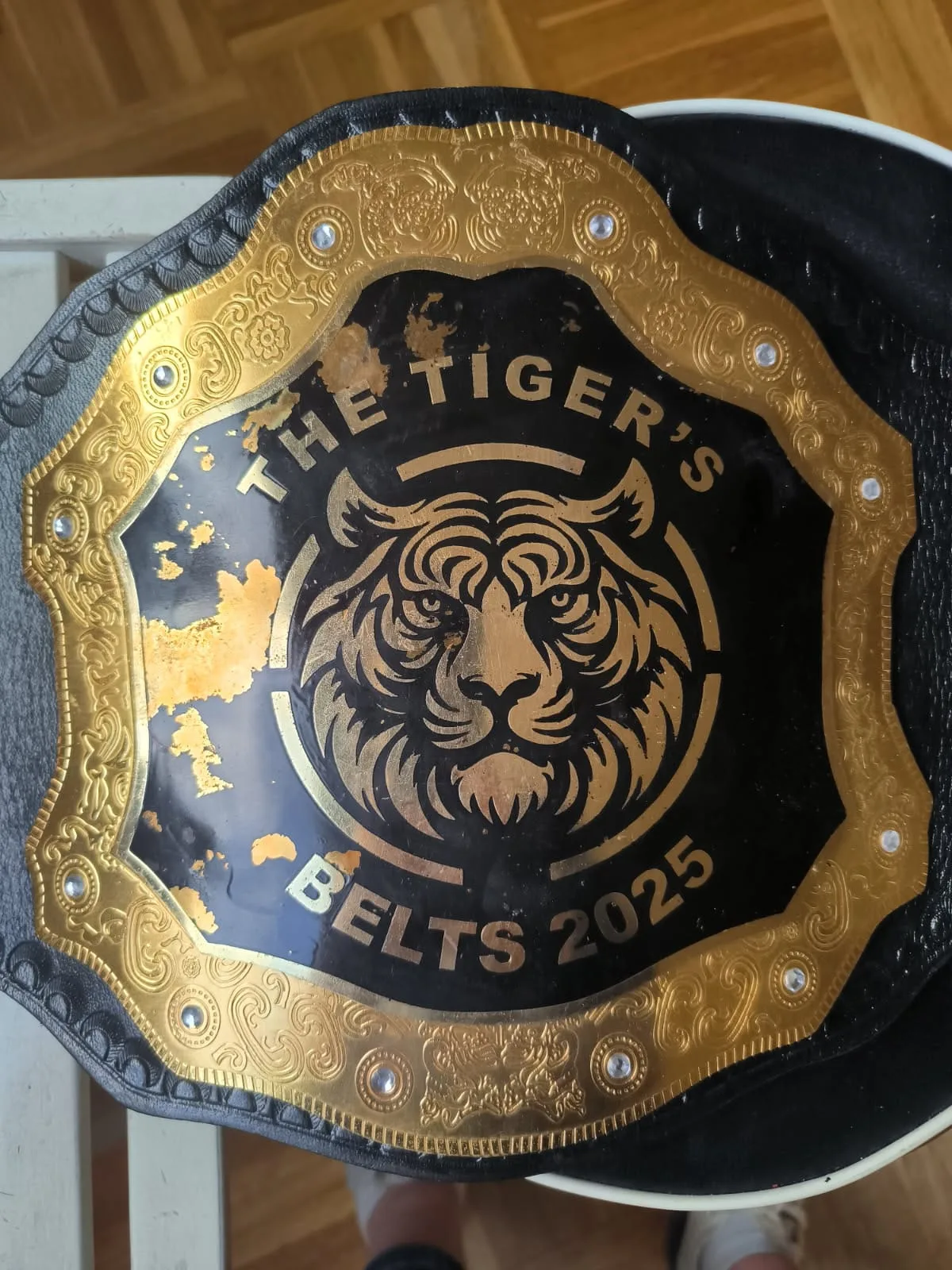
Direct answer: Custom championship belt cost depends on the quantity, design and metalwork scope, finish, artwork approval, production timing, destination and shipping terms. This guide shows event and procurement buyers what to prepare before comparing quotes, without publishing a fixed PunchPowerUp price.
For PunchPowerUp, the standard belt MOQ is 10 pieces. A standard 10-piece order and a one-belt request may follow different quotation routes. A one-belt route may involve an additional sample fee, but it should not be treated as the same thing as a sample unless the quotation explicitly defines it that way. The most useful first step is to fix the project brief, then ask the supplier to price the same scope. A number without that scope is difficult to compare.
What a comparable belt quote should include
| Quote input | How it can affect the quoted scope | What to confirm before comparing |
|---|---|---|
| Quantity | Ten belts and one belt are different procurement routes. | Quantity, whether the order is a standard bulk run, and whether a one-belt route is available. If a separate sample is needed, list it separately. |
| Plate and layout | Main plate size, side plates, wording and logo arrangement change the design and metalwork brief. | Which plates are required, what text and logos appear on each plate, and whether side plates are part of the design. |
| Finish and colour | Electroplating, baked paint and custom colours define the visible finish. | Finish direction, colour references and any areas that must remain visually distinct. |
| Strap and backing | Strap and backing/lining are part of the finished scope, not an afterthought. | The intended strap and backing description, plus any design detail that needs written confirmation. |
| Artwork and approval | Unclear artwork creates revision and approval risk. | Source files, approval owner, the included revision boundary and the point at which manufacturing can begin. |
| Timing | Production planning is separate from shipping, customs and final arrival. | Event date, required review point, production plan, shipping route and destination. |
| Logistics | Freight, importer responsibility and destination terms form part of the delivered quotation scope. | FOB or another written term, destination, VAT/duty responsibility and whether a belt DDP assessment is available. |
The table is a scoping tool, not a price calculator. A supplier should confirm the final commercial terms for the actual design and destination.
The safest way to compare custom belt quotations is to give every supplier the same quantity, design scope, artwork status, deadline and destination.
The main factors behind a custom belt quotation
1. Quantity and the one-belt question
Quantity affects the shape of the project. PunchPowerUp’s standard MOQ is 10 pieces. If you need one belt, ask whether a one-belt route is possible and how it will be handled in the quotation. A standard 10-piece order and a one-belt request may follow different quotation routes. If a separate sample is also required, state it separately; do not assume the one-belt route and sample are the same.
For an event, state whether you need one champion’s belt, several awards, replacement units or a repeatable series. That answer helps the supplier understand whether the brief is for a one-belt route, a separate sample request, a bulk order or a design that may be repeated later.
Budgeting by material across quantities. Three confirmed per-belt reference prices exist for planning purposes: iron-finish belts at $170 each, brass-finish belts at $250 each, and a pure-gold-plated finish at approximately $1,300 each. The gold-plated route also carries a one-time mould/tooling charge of approximately $3,500 for that design — this is charged once per design, not per unit, and production planning for it runs around a month. These are reference points for the base metalwork only: plate count, finish detail, artwork and freight are added on top and quoted separately based on the actual order, and the one-belt route may carry its own fee as described above. None of the figures on this page include shipping — freight is quoted against the confirmed quantity and destination.
| Quantity | Iron reference ($170 each) | Brass reference ($250 each) | Gold-plated reference ($1,300 each) | Note |
|---|---|---|---|---|
| 1 belt | ~$170 | ~$250 | ~$1,300 + $3,500 mould/tooling (one-time) | One-belt route; may include an additional fee — confirm on your quote. Shipping is not included in any column |
| 10 belts (standard MOQ) | ~$1,700 | ~$2,500 | ~$13,000 + $3,500 mould/tooling (one-time, not per belt) | Standard bulk route |
| 20+ belts | ~$3,400+ | ~$5,000+ | ~$26,000+ + $3,500 mould/tooling (one-time, not per belt) | Still quoted individually — see below |
The $3,500 mould/tooling charge on the gold-plated route is a one-time cost tied to the design, not multiplied by quantity — it is the same whether the order is for 1 belt or 10.
There is no published volume discount for orders above the 10-piece minimum. Each quantity above 10 is priced on its own merits rather than against a fixed per-unit discount schedule, so don’t assume the per-belt rate drops automatically as the order grows — ask for it to be confirmed in writing.
2. Plate layout and metalwork scope
The design brief should show the main plate, any side plates, wording, logos and the intended hierarchy. The confirmed belt vocabulary includes a brass main plate, brass side plates where specified, machine metal engraving, electroplating and baked paint. These are useful terms for the quoted scope, but they do not replace a final drawing or approved artwork.
Ask whether any mould, tooling or setup charge applies to the particular design. For the pure-gold-plated route, PunchPowerUp’s reference figure is approximately $3,500, charged once per design rather than per unit; for iron and brass finishes there is no standard tooling charge and the amount stays quote-specific. Either way, the important comparison is whether two suppliers have priced the same plate count, detail and finish.
3. Finish, colour, strap and backing
Finish choices form part of the quoted scope. State the plating direction, paint areas and custom colours rather than sending a logo alone. The confirmed construction vocabulary includes a synthetic/faux leather strap and leather plus fabric backing/lining. If your event requires a different material, texture or construction, treat that as a question for written confirmation.
4. Artwork, payment and approval
Approved artwork inputs include AI, PSD and SVG files, along with other high-resolution source files. PunchPowerUp’s current route requires 100% full payment before formal custom artwork/design begins. One artwork revision is confirmed, and final artwork approval comes before manufacturing. This payment and cancellation structure applies the same way whether you’re ordering one belt or ten: if you cancel after final artwork approval but before manufacturing starts, 30% of the order value is retained as a design fee and 70% is refunded; once manufacturing has started, the order can’t be cancelled for a change of mind — a stricter boundary than typical off-the-shelf retail, since made-to-specification goods are treated differently from stock items under EU consumer contract rules. This doesn’t affect your statutory rights if goods arrive defective, damaged, or not as described.
This sequence matters when comparing a “design included” statement. Ask what design support means, when the formal design stage starts, how many revision rounds are included and who gives final approval. Keep the approved artwork as the manufacturing reference once the brief is signed off.
5. Production planning is not delivery
Typical planning figures are approximately 20 working days for a sample or one-belt route, 30 working days for standard bulk (10 pieces) and 40 working days during peak periods. These are planning figures, not a promise that the belt will arrive by an event date. Rush belt production is not supported, at any quantity.
The event date, destination and required review point should be included in the first RFQ. Production is followed by shipping and customs, so a quote that shows only a production estimate is not a complete arrival estimate.
6. Shipping, VAT and duty
FOB is confirmed for the belt route. Belt DDP can be assessed for eligible destinations, but that does not mean every destination or every quote is tax-inclusive. VAT and duty default to the buyer or importer unless written terms state otherwise. Ask for the destination-specific responsibility, carrier, freight treatment and customs assumptions in writing.
Why starting with one belt can catch problems before they multiply across ten
There’s a practical reason to take the one-belt route seriously even if your event ultimately needs a full 10-piece order: on one order, a supplier quality issue wasn’t caught until the full 10-piece run was already underway, which meant the entire batch — not just one unit — had to be reworked against the clock. A version of this record, anonymized, is documented on our portfolio and proof page. (The customs/VAT-EORI side of that same order is covered in how early to order before your event — this section is about the production-quality side of it.)
The lesson isn’t “always order a sample” — plenty of standard 10-piece orders go through without needing one. It’s that if a design has any untested element (a finish, a plate detail, a construction choice you haven’t used before), routing it through a single unit first gives you a checkpoint before the full batch is committed, rather than discovering a quality issue only once all ten are already in production.
A practical event scenario
Imagine a league needs ten belts for an event and wants a main plate, side plates, two colours and a specific approval deadline. A weak RFQ might send only a logo and the event date. A useful RFQ would also state the quantity, plate layout, wording, colours, finish, strap/backing preference, artwork files, approval owner, destination and whether the buyer wants a pre-shipment visual review where applicable.
The second brief gives suppliers the same scope to price. It also makes unknowns visible: the buyer can ask about any mould or tooling charge, exact freight, customs responsibility and the timing of the final arrival instead of treating assumptions as included.
Buyer checklist before requesting a belt quote
- Quantity, including whether you need a one-belt route or a ten-piece-or-more order.
- Event date, destination and the date by which artwork must be approved.
- Main plate, side-plate and wording layout.
- Logos, colours, finish direction and any design references you have rights to use.
- Preferred strap and backing description.
- AI, PSD, SVG or other high-resolution artwork files.
- The person who can approve the final artwork.
- Whether you need a one-belt route or a separate sample, and how you want pre-shipment photos/video handled where applicable.
- Written confirmation of production planning, shipping term, freight treatment and VAT/duty responsibility.
Frequently asked questions
Is there a standard price for a custom championship belt?
No single responsible price applies before the quantity, design scope, finish, artwork and destination are known. Competitor catalogue prices are not a PunchPowerUp quote. Request a quotation against a defined brief so the number includes the same plates, finish, timing assumptions and shipping terms that you are comparing elsewhere.
What is the MOQ for custom championship belts?
PunchPowerUp’s standard MOQ is 10 pieces. That is a confirmed planning rule for the normal route. If your project needs fewer than 10, ask whether a one-belt route is possible and whether an additional sample fee applies. If you also need a separate sample, ask for that route to be described separately. The supplier should confirm the applicable amount and timing in the quotation rather than treating the one-belt route as standard bulk production.
Can I order one custom championship belt?
A standard 10-piece order and a one-belt request may follow different quotation routes. A one-belt route may involve an additional sample fee, but a separate sample request should be identified separately. Provide the complete design, event date and destination when you ask. That allows the supplier to confirm the route and timing without turning a possibility into a guarantee.
Does ordering more than 10 belts lower the price per belt?
Not automatically. There’s no published volume discount above the 10-piece minimum — each quantity is quoted on its own terms, so ask for the per-unit rate to be confirmed in writing rather than assuming it scales down.
Does the design affect the quotation?
It can affect the quoted scope. Plate count, side-plate details, wording, logo layout, finish, colours and other order-specific design requirements all belong in the comparison brief. Ask whether a mould, tooling or setup charge applies to the actual design, but do not assume one applies to every belt or publish an amount that has not been quoted for your project.
How long does custom belt production take?
Typical planning figures are about 20 working days for a sample or one-belt route, 30 for standard bulk and 40 during peak periods. These figures describe production planning, not shipping, customs or final delivery, and they are not a promise for a fixed event date. Rush belt production is not supported, so share the deadline at the first enquiry.
Does the quote include shipping, VAT and duty?
Ask the supplier to state the shipping term, freight treatment, importer responsibility and destination-specific customs assumptions. FOB is confirmed for PunchPowerUp belts, and DDP can be assessed for eligible destinations, but DDP is not a universal promise. VAT and duty default to the buyer or importer unless written commercial terms state otherwise.
What should I send a supplier before asking for a belt quote?
Send the quantity, event date, destination, logos and wording, plate layout, colours, finish, strap or backing preference, artwork files and approval owner. Also state whether you need a one-belt route, a separate sample, or a standard bulk order. A complete brief lets the supplier identify missing decisions and return a quotation that is easier to compare.
Related reading
- For the product route, see Custom Championship Belts
- For a broader preparation checklist, use the Custom Boxing Gear Quote Guide
- If your event has a fixed date, read How Early Should You Order Custom Championship Belts Before a Boxing Event? (linked above, in the one-belt-first section)
- See how to make sure the finished belt matches the approved artwork
- For an honest, anonymised example of how a production issue and customs timing can affect a fixed-date order, see Portfolio / Proof
When the brief is ready, use Get a Custom Boxing Product Quote and include the quantity, artwork, deadline and destination.
Editorial note: Product specifications and commercial rules are stated only where verified. Published and updated dates come from the WordPress post record.