
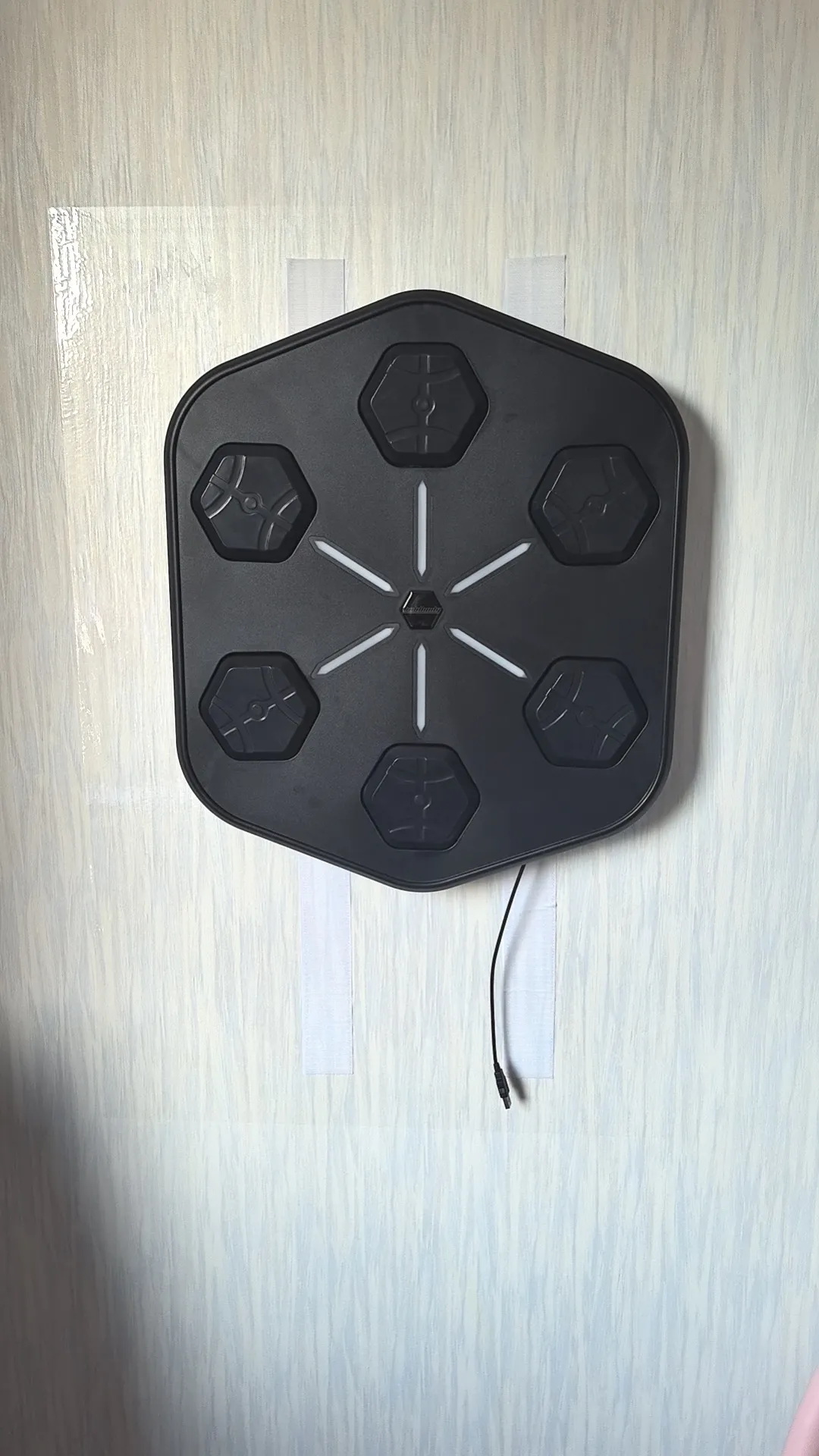
Direct answer: Searching commercial vs home boxing machine options? Short answer: there isn’t a separate model to compare. PunchPowerUp’s Smart Boxing Machine ships as one configuration — there’s no separate “commercial” or “home” version. The real question isn’t which model to buy; it’s how usage frequency, shared-space responsibility, noise, and mounting play out differently on a gym floor versus a home wall. Same six-target, 15W, EU-plug unit and 12-month warranty either way — the planning differs by context, not by hardware.
One machine, two very different use patterns
| Factor | Gym or club floor | Home wall |
|---|---|---|
| Hardware | Se-03, six targets, music-reactive | Se-03, six targets, music-reactive (same unit) |
| Users | Many people, rotating | Typically one household |
| Frequency | Multiple sessions per day | Occasional to daily |
| Setup responsibility | Usually falls to staff or the owner | Falls to whoever mounts it |
| Noise consideration | Absorbed into general gym noise | More noticeable in a quiet home |
Nothing in that table is a different product — it’s the same $249, DDP-priced, 12-month-warranty unit either way. What changes is who’s responsible for it and how much wear-and-tear planning matters.
Usage frequency and what it actually changes
A gym machine gets used by dozens of different people across a day; a home unit gets used by one household at whatever pace they choose. The warranty and defect process don’t change based on that: confirmed defects are replaced under the 12-month warranty regardless of setting, and the buyer pays return shipping for the defective unit either way — on top of that, EU consumers also have statutory guarantee rights that this warranty doesn’t override. What does change is exposure — more users and more sessions naturally means more chances for something to go wrong sooner, so a gym owner has more reason to keep the order confirmation and warranty terms on hand from day one, rather than assuming a home-use timeline for wear.
We don’t have published data on a maximum recommended daily use or a durability rating under high-frequency conditions — if that matters for your planning, it’s worth asking directly rather than assuming a number.
Shared-space use in a gym or club — what falls on the operator
In a multi-user setting, a few responsibilities land squarely on whoever runs the space, not on PunchPowerUp:
- Initial setup and app registration. One early batch shipped with an app registration screen available only in Chinese, which caused setup problems for several European buyers before English onboarding was added. In a gym, this is a one-time setup step done by staff — worth confirming current app language support before opening day rather than during it.
- Ongoing app/account management. If multiple staff need to interact with the unit’s app-based features, that’s an internal access question for the venue to sort out — it isn’t something PunchPowerUp manages remotely.
- Mounting to a suitable wall. Wall-mounting hardware is included and no professional installer is required, but in a commercial space this usually means facilities or maintenance staff signing off on the wall type and location, not just a quick DIY job.
If you’re running more than one location, a documented pattern worth knowing about: one European buyer has ordered from PunchPowerUp continuously for more than two years, across multiple colorways, handled as a series of individually negotiated repeat orders rather than a standing distributor contract — a real example of how multi-site ordering has actually worked here, not a hypothetical.
Noise and mounting — why the same unit feels different at home
In a gym, the machine’s sound blends into general floor noise — music, other equipment, conversation. In a home, especially an apartment or a room shared with neighbors, the same unit is more noticeable simply because the ambient noise floor is lower. We don’t have published decibel data for this machine, so if noise is a real constraint in your home — thin walls, close neighbors, a shared building — that’s worth raising directly before you order rather than guessing from the spec sheet. If you’re not sure how to raise it — what to actually test, and how to time that conversation with neighbours — see our guide to planning boxing machine noise before you mount.
Wall type matters here too: the included mounting hardware assumes a wall capable of taking it securely, and that’s the buyer’s responsibility to confirm in either setting. A concrete gym wall and a stud-and-drywall home wall aren’t the same installation problem, even though the hardware in the box is identical.
For the full mounting sequence — wall checks, power planning, bracket, and first power-on — see the complete installation walkthrough.
Ordering one unit vs ordering for multiple locations
- Home or single-location trial. Minimum order is 1 unit at $249 DDP — a reasonable way to try it before assuming it fits your routine or your household.
- Second location or a growing gym chain. Additional units are separate orders rather than an automatic bulk discount; pricing isn’t tiered below 10 units.
- 10 or more units across locations. Case-by-case negotiation applies. If you’re ordering for multiple sites, go through the case-by-case ordering route (linked below) instead of placing separate single-unit orders at listed price.
Frequently asked questions
Is there a more durable “commercial” model for gyms?
No — there’s one configuration of the Se-03, used in both gym and home settings. We don’t have published durability or duty-cycle data specific to high-frequency use, so if that’s a hard requirement for your venue, ask before ordering.
Is the warranty different for commercial use?
No. The same 12-month warranty and defect-replacement process apply regardless of setting — confirmed defects are replaced, and the buyer covers return shipping on the defective unit.
Will it be too loud for an apartment?
We don’t have published noise-level data for this machine. If you’re in a noise-sensitive home — an apartment, a shared wall, close neighbors — that’s a question worth asking directly rather than assuming either way.
Can a gym order a few units to start and add more later?
Yes. Ordering one or two to test response is reasonable at the standard $249 per-unit price; additional units later are separate orders, and 10+ at once can be negotiated as a single quote instead.
Who’s responsible for mounting it in a gym versus a home?
The buyer, in both cases. Wall-mounting hardware is included and no professional installer is required, but confirming the wall can take it securely is the buyer’s or venue’s responsibility either way.
Related reading
- For a full walk-through of venue fit and how to size your order, see the venue-sizing and ordering guide
- For the manufacturer/seller relationship and what can’t be customized, see how the manufacturer/seller responsibility splits
- Ordering across multiple locations? Start with the case-by-case route for ordering across multiple locations
- Read a documented multi-year, multi-location order pattern on our portfolio and proof page
- See the Smart Boxing Machine product listing itself
Deciding between a home trial and a multi-location order? Get a quote for a single unit or a multi-unit order.
Editorial note: Product specifications and commercial rules are stated only where verified. Published and updated dates come from the WordPress post record.