
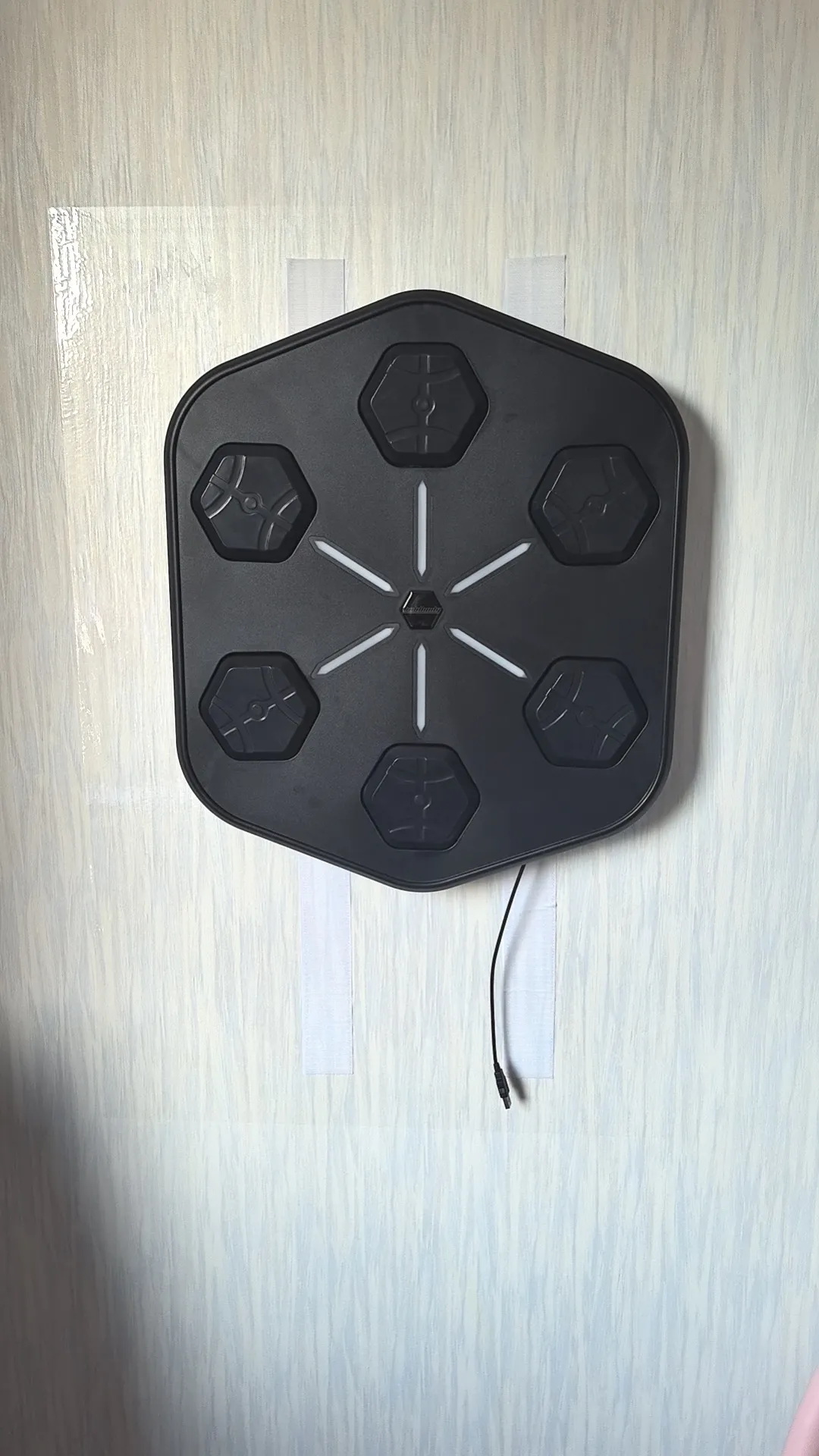
Direct answer: There’s no published decibel rating for the Smart Boxing Machine, so “how loud will it be” isn’t a question we can answer with a number. What you can plan for: the volume is adjustable, so test it at a realistic level before you pick a permanent spot, treat a shared-wall apartment differently than a detached house, and raise it with neighbours or your building beforehand if you’re in doubt — planning around the uncertainty, not around a spec that doesn’t exist.
What “no published noise data” actually means for your planning
This isn’t a case of information we’re holding back — it’s never been measured, so there’s no number to share either way. That matters more for this product than it might for other gym equipment, because it’s music-reactive: the sound isn’t just the strike itself, it’s also the built-in speaker playing music and effects through the unit. Two different sources of sound, both coming from a fixed wall-mounted point rather than something you can carry to a quieter room.
Without a spec to check, the planning has to happen at the behavioural level instead — testing, timing, and communication — rather than looking up a number and comparing it to a noise limit.
The volume is adjustable — use that before you mount anything permanently
One thing worth knowing upfront: volume is adjustable, not fixed at one level. That’s the single most useful lever you have, and it’s worth using deliberately rather than assuming the default setting is what you’re stuck with. We don’t yet have a published walkthrough of exactly where the volume control lives in the menu, so if you can’t find it right away, that’s a setup question worth asking us directly rather than assuming there isn’t one.
Test it like you’ll actually use it, not in a quiet showroom scenario: run it at the time of day you’d realistically train, with doors and windows in whatever state they’re normally in — not artificially sealed for a test. Try it at a couple of different volume levels before you commit to a permanent wall position, so you know what a comfortable level sounds like from the next room, not just from arm’s length.
Apartment vs house: same product, different planning
Shared-wall or shared-floor apartments are the default context for a lot of European buyers, and they’re also where a fixed volume level matters most: sound travels through party walls and floors in ways that are hard to predict from inside your own unit. If this is your setup, treat the volume test above as non-negotiable before you finalise a wall — and lean toward a lower default level than you’d use in a detached house, at least until you’ve confirmed it’s not carrying through to a neighbour’s space.
Detached or semi-detached houses generally give you more room for error, but “more room” isn’t “no planning needed” — an exterior wall shared with a neighbour’s garden, a home office on the other side of an interior wall, or a household member who works irregular hours are all still worth a moment’s thought before you mount anything permanently.
Should you say something to neighbours or your building first?
This depends more on your living situation than on the product itself:
- If you own and live in a detached property, this is entirely your call — test at a level you’re comfortable with and go from there.
- If you’re in a shared-wall building — owned or rented — a short heads-up to immediate neighbours before your first real session is a low-cost way to avoid a cold first impression. It doesn’t need to be formal.
- If you rent, check your tenancy agreement or ask your landlord about any restrictions on wall-mounted equipment or noise, separate from the neighbour conversation. That’s a permissions question, not a courtesy one, and it’s worth resolving before you drill rather than after.
- If your building has a residents’ association or specific quiet-hours rules, that’s worth checking too — a heads-up to a neighbour doesn’t override a building rule you didn’t know existed.
A short heads-up and formal permission are two different things — know which one your situation actually calls for before you assume a friendly conversation covers it.
Choosing a spot and a use-time window, not just a wall
Once you’ve tested at a level you’re happy with, the spot itself is still a decision worth making deliberately — not purely on which wall is structurally convenient. (The structural side — what kind of wall can actually take the mounting hardware — is covered separately in our installation walkthrough; this is about where that structurally sound wall sits relative to the people around you.) A wall shared with a nursery, a home office, or a neighbour’s bedroom is a different decision than an interior wall backing onto a hallway or utility room, even if both are structurally identical.
The same logic applies to timing: if you know a household member works nights, or your neighbour keeps unusual hours, picking a default use-time window is as much a part of planning this as picking the wall.
What an early setup issue taught us about the first session
Worth mentioning here because it lands on the same first session as your volume test: an early batch of these machines shipped with an app registration screen available only in Chinese, which left several European buyers stuck before English onboarding was added. If you hit a language snag during setup, it’s a known issue rather than something wrong with your unit — but it’s also a reminder that your first power-on is doing double duty: getting the app paired, and getting your first real read on the volume. Don’t rush through the second part just because the first part took longer than expected. If a language snag is what brought you here, see our dedicated guide to the app itself for what to check.
Signs it’s worth changing your setup after the fact
- A neighbour raises it directly with you — that’s a clearer signal than trying to judge it yourself from inside your own space.
- You notice you’re avoiding certain times of day to use it, which usually means the volume or timing hasn’t actually been resolved, just avoided.
- You moved in without testing at a realistic level first and are now guessing retroactively — worth doing the test in the “test it like you’ll actually use it” section above, even after the fact.
If any of these apply, the volume control is still there — revisit it rather than assuming your only options are living with it or taking it down.
Frequently asked questions
Do you publish a decibel rating for this machine?
No. It hasn’t been measured, so there’s no number to share in either direction — planning has to happen through testing and communication instead.
Can I turn the volume down?
Yes, volume is adjustable rather than fixed. We don’t have a published step-by-step for the exact control location yet — if you can’t find it, ask us directly during setup.
I rent my apartment — do I need permission before mounting it?
Check your tenancy agreement or ask your landlord. That’s separate from — and comes before — any conversation with neighbours.
Should I tell my neighbours before I mount it, or just try it and see?
A short heads-up before your first real session is generally the lower-risk option in a shared-wall building. It doesn’t need to be formal, but it avoids a cold first impression.
What if it turns out to be too loud after I’ve already mounted it?
Start with the volume control and a change in use-time before assuming you need to remount or return it — those are the two levers most likely to actually resolve it.
Does the warranty cover noise complaints?
No — the 12-month warranty covers confirmed defects in the unit itself, not how it’s received by neighbours or a building. That said, EU consumers retain statutory rights that exist independently of any product warranty, if a dispute goes beyond a straightforward volume or timing fix.
Related reading
- For the fuller gym-vs-home noise comparison, see commercial vs home boxing machine
- For the wall-check and power-planning walkthrough, see how to install a wall-mounted boxing machine
- Still deciding if this fits your space? See the buyer’s guide on venue fit and sizing
- Check the current spec sheet on the product page
Have a specific room or shared-wall setup you want to talk through before ordering? Ask us about your specific room or wall setup.
Editorial note: Product specifications and commercial rules are stated only where verified. Published and updated dates come from the WordPress post record.